Top 10 Mineral Oil Based Defoamers for Global Buyers
For global buyers, selecting a Mineral Oil Based Defoamer requires more than comparing prices or viscosity figures. Foam behavior changes with temperature, shear, surfactants, pigments, and processing speed. A product that performs well in paper coating may fail in wastewater treatment or construction chemicals. Small laboratory differences can become serious production losses.
Defoaming researcher P. R. Garrett is widely associated with practical foam-control studies. His work supports this useful principle: “Defoaming is not simply the destruction of foam; it is the control of foam within a process.” That distinction matters. A strong Mineral Oil Based Defoamer should collapse surface foam quickly, disperse evenly, and avoid craters, fisheyes, or unwanted surface defects. It should also remain stable during storage and transportation. Check the data sheet carefully.
This Top 10 guide evaluates products through a buyer’s lens. It considers foam knockdown, persistence, compatibility, dosage range, handling, and application fit. The review also examines technical documentation and supplier transparency. Some rankings may remain debatable. Performance depends heavily on formulation details and operating conditions. That is worth admitting.
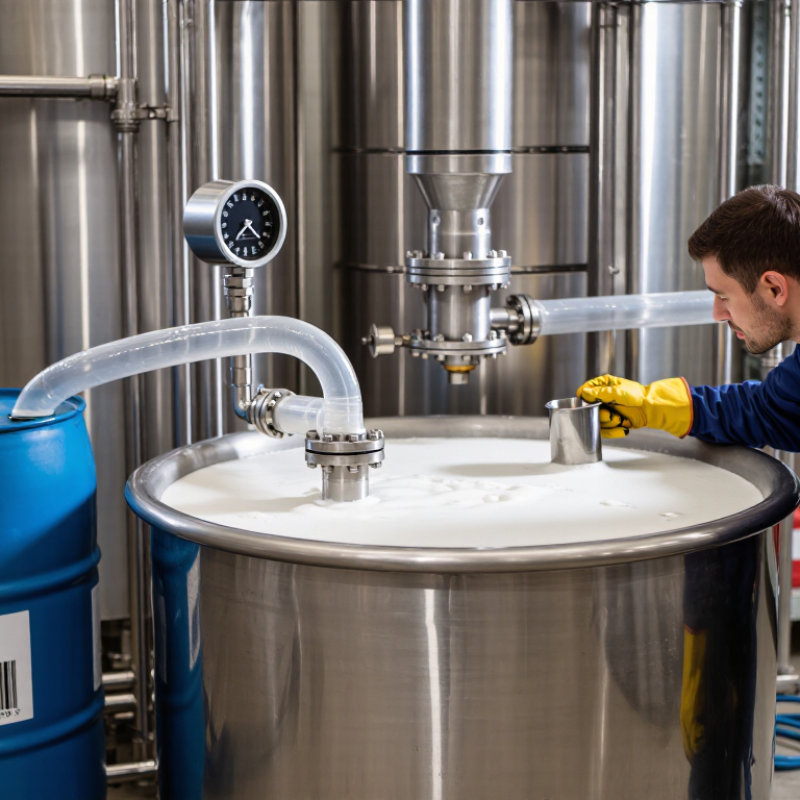
In real production, a drum beside a mixing tank tells its own story. Operators watch the foam line, pump vibration, filter pressure, and coating appearance. These details often reveal more than a brochure. Global purchasers should request samples, conduct controlled trials, and confirm regulatory documentation before making a large order. No single product suits every plant. The best choice is the one that controls foam reliably without creating a second problem.
Mineral Oil Based Defoamers: Definition, Composition, and Core Functions
Mineral oil based defoamers are foam-control additives made with refined mineral oil as the continuous phase. They contain hydrophobic particles, emulsifiers, waxes, or blended silicone-free components. The exact composition varies with the process, temperature, and foam type. In practical plant trials, a small dosage can change surface behavior quickly.
Their core function is simple: they enter foam films and weaken them. The oil spreads across air-liquid interfaces, while hydrophobic particles help rupture unstable bubbles. This reduces surface foam, trapped air, pinholes, and overflow risks. Common uses include water treatment, coatings, adhesives, pulp processing, and industrial cleaning. However, performance depends on viscosity, shear, pH, and compatibility with other additives. A product that works well in a storage tank may fail inside a high-speed mixer. That is often overlooked.
Tips: Run jar tests before full-scale purchasing. Compare foam knockdown, persistence, and residue after mixing. Check the technical data sheet and safety documentation. Buyers should also confirm storage conditions, transport requirements, and application-specific compliance. Do not assume a higher dosage gives better control. Excess defoamer may create surface defects or reduce coating quality. Small-scale results can mislead, too. Recheck performance under real temperature and agitation conditions.
How Mineral Oil Defoamers Work in Industrial Formulations
Top 10 Mineral Oil Based Defoamers for Global Buyers
How Mineral Oil Defoamers Work in Industrial Formulations
Mineral oil based defoamers control unwanted foam by spreading across bubble surfaces. Their oil phase has low surface tension. This helps it enter unstable foam films. Hydrophobic particles then disturb the film structure and encourage bubbles to collapse.
In water-based coatings, adhesives, cleaners, and wastewater formulations, the defoamer must travel quickly. A small dose can reduce foam during mixing, pumping, or filling. Too much can cause surface defects, craters, or poor coating appearance. Not always better.
Performance depends on viscosity, temperature, shear rate, and formulation chemistry. For example, a defoamer may work well in a cool tank but lose efficiency near a heated filling line. Operators should test samples under real mixing conditions. Observe foam height, collapse time, gloss, and reappearance after ten minutes.
Mineral oil defoamers often offer good persistence and practical cost control. However, compatibility remains a critical concern. Poor dispersion may create oily spots or reduce adhesion. This is where experience matters: add the defoamer gradually, then inspect the finished material after storage. A laboratory result can mislead when production equipment creates stronger shear.
Water hardness, surfactant concentration, and pigment loading also influence results. Buyers should request technical data, safety information, and recommended dosage ranges. They should also verify suitability for the intended industrial process. Small adjustments can change the outcome.
Top 10 Mineral Oil Based Defoamers for Global Buyers
How Mineral Oil Defoamers Work in Industrial Formulations
The chart shows representative working dosage levels commonly used for mineral oil based defoamers in industrial formulations. Mineral oil droplets spread across foam films, weaken the liquid-air interface, and promote bubble coalescence. Actual dosage depends on formulation chemistry, shear, temperature, surfactant concentration, and process conditions.
Top 10 Mineral Oil Based Defoamers for Global Buyers
Top 10 Mineral Oil Based Defoamers for Global Buyers
The top 10 mineral oil based defoamers should be judged by application, not price alone. Global buyers typically compare foam control, emulsion stability, dosage, and regulatory documentation. MarketsandMarkets’ 2024 Defoamers Market report projects continued growth through 2029, supported by paper, coatings, and water-based processing. Meanwhile, FAO reported global paper and paperboard production above 400 million tonnes annually. These figures show why reliable foam control remains important in high-speed mills.
A practical shortlist includes standard mineral oil defoamers, low-odor grades, high-temperature formulas, paper coating grades, wastewater-treatment grades, latex-compatible grades, pigment-dispersion grades, alkaline-process grades, low-dosage concentrates, and formulations designed for cold storage. Experienced users check performance at the actual shear rate. A product that works in a laboratory beaker may fail inside a turbulent pipeline. I have seen overdosing reduce surface quality and create oily spots. That detail is easy to miss.
Tips: Request technical data sheets, safety data sheets, and migration information before purchasing. Test at 0.05%, 0.1%, and 0.2% dosage levels. Record foam height, collapse time, gloss, and filterability. ASTM and ISO methods can improve comparisons, but plant trials still matter. Buyers should also verify local chemical inventory requirements, VOC expectations, and transport conditions. The cheapest option may become expensive after rejected batches, especially when storage temperatures fluctuate.
Key Performance Criteria for Comparing Defoamer Products
Global buyers should compare mineral oil based defoamers through measurable performance, not price alone. Grand View Research estimated the global defoamers market at approximately USD 6 billion in 2023, reflecting strong demand across coatings, pulp and paper, food processing, and industrial fluids. That scale makes reliable product screening essential.
Start with foam knockdown speed and persistence. A useful test records foam height after 10, 60, and 300 seconds. ASTM D1173 can support comparative foam testing in aqueous systems, while production trials reveal shear and temperature effects. Check performance at the actual process temperature. A defoamer that works at 25°C may weaken near 70°C. Fast action matters. Long persistence matters more.
Compatibility deserves equal attention. Examine surface defects, gloss loss, craters, filtration blockage, and sediment after storage. Mineral oil viscosity, particle size, and emulsifier selection can change results significantly. A 2024 technical review from the European Coatings Journal emphasized dosage efficiency and application compatibility as major formulation priorities. Yet laboratory rankings can mislead. Higher dosage may reduce foam while harming coating appearance or paper formation. Compare the lowest effective dosage, not the strongest initial result. Review safety data, food-contact status where relevant, volatile content, and regional chemical requirements before approval. The comparison will remain imperfect, but documented pilot trials make decisions more defensible.
Global Purchasing, Compliance, and Application Considerations
Top 10 Mineral Oil Based Defoamers for Global Buyers
Global buyers should evaluate mineral oil based defoamers beyond price and advertised foam control. A reliable comparison starts with the technical data sheet, safety data sheet, and certificate of analysis. Check active content, viscosity, density, flash point, storage temperature, and batch consistency. Documents must match the shipment. That detail is easy to overlook.
Compliance depends on the destination, industry, and final application. Buyers should review current chemical registration, labeling, transport, and workplace requirements in each market. Food, pharmaceutical, personal care, and water-related uses require extra scrutiny. Do not assume industrial approval covers every application. Ask for composition disclosure, restricted-substance statements, and suitable-use declarations. Independent verification may still be necessary.
Application testing should reflect real production conditions. Compare the ten candidates at the same dosage, shear rate, temperature, and mixing time. Observe foam knockdown, persistence, surface defects, and re-foaming after several hours. A small laboratory beaker can mislead. Test in the actual process stream when possible. For coatings, check gloss and cratering; for wastewater, monitor dispersion and downstream treatment effects. Packaging also matters, especially for long ocean shipments or cold storage. I would request retained samples and traceable lot numbers. Still, no checklist replaces a plant trial. Some results remain inconsistent, and that deserves honest review.
