Hard water leaves a familiar signature: white scale on a kettle, cloudy shower glass, and a gritty ring around a faucet. The U.S. Geological Survey classifies water above 120 milligrams per liter as calcium carbonate as hard, and above 180 milligrams as very hard. These minerals are not usually considered a direct health danger. However, they can react with soap and form deposits inside heaters, pipes, valves, and appliances.
A Hard Water Descaler is designed to reduce the practical effects of scale without necessarily removing calcium or magnesium. Depending on the technology, it may use electromagnetic fields, electronic signals, catalytic media, or template-assisted crystallization. The intended result is different mineral behavior. Instead of strongly attaching to metal surfaces, some dissolved minerals may form tiny suspended crystals that travel with the water. The idea sounds simple. Real results are less uniform.
The Water Quality Association distinguishes scale-control devices from ion-exchange water softeners, which physically reduce hardness ions. That distinction matters when comparing product claims. NSF/ANSI standards commonly associated with softeners do not automatically validate every descaler design or performance statement. The World Health Organization also notes that drinking-water hardness is mainly an acceptability and household-use issue, rather than a universal health concern.
This article examines how a Hard Water Descaler works, where its claims are credible, and where evidence remains limited. Field conditions matter. Water chemistry, temperature, flow rate, and pipe material can change the outcome. A device that performs well in one home may disappoint in another. That uncertainty deserves honest attention, not polished promises.
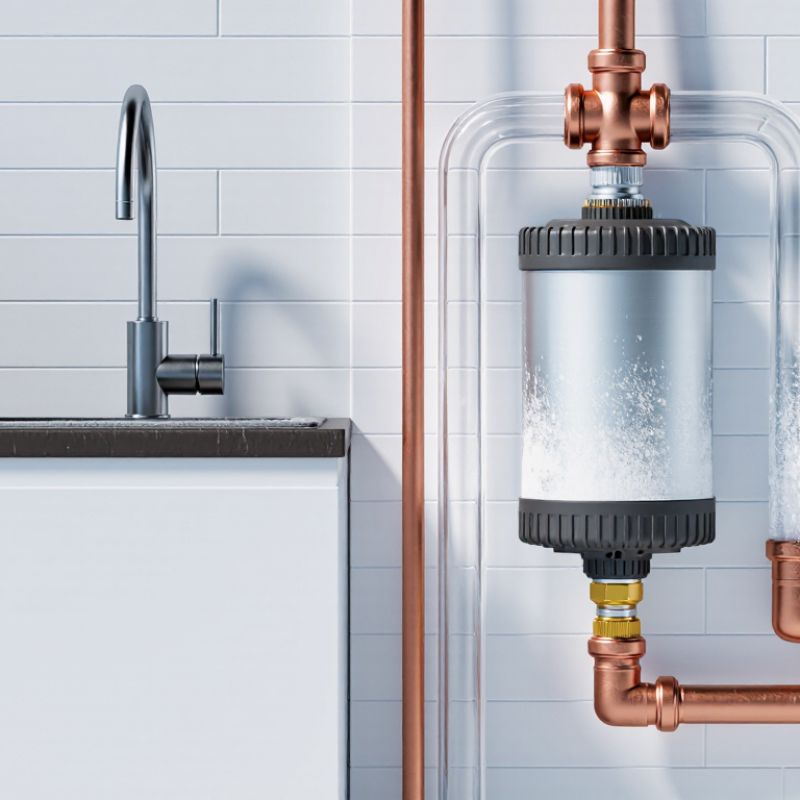
Hard water describes water carrying dissolved calcium and magnesium. The U.S. Geological Survey classifies 121–180 milligrams per liter, measured as calcium carbonate, as hard water. Above 180 mg/L, water is considered very hard. A test result near 150 mg/L may leave white scale on faucets, shower glass, kettles, and heating elements.
Visible deposits are only part of the issue. The World Health Organization reports that calcium and magnesium contribute to water hardness, although it does not set a health-based limit for hardness. Hard water can also reduce soap performance and create rough mineral films. The U.S. Geological Survey explains that hardness commonly comes from groundwater moving through limestone, chalk, or other mineral-rich formations.
A hard water descaler aims to reduce scale formation without removing most dissolved minerals. Electronic, magnetic, or media-based systems may alter how crystals form or attach to surfaces. Their performance can vary with flow rate, temperature, plumbing design, and mineral composition. That matters in real homes. A device that performs well in a controlled test may behave differently beside an older water heater.
Descaler is not the same as softener. Ion-exchange softeners remove calcium and magnesium more directly, while descalers generally leave hardness minerals in the water. Test before choosing. Retest after installation. Results can be disappointing when claims exceed evidence.
Hard water leaves visible clues: a white ring inside the kettle, cloudy shower glass, and stiff laundry. A descaler aims to reduce scale formation without removing dissolved minerals. Depending on its design, it may use magnetic, electronic, or catalytic methods. These systems can influence how minerals crystallize, but results vary with water chemistry and flow conditions. They do not usually remove calcium or magnesium.
A water softener works differently. It uses ion exchange resin to capture Ca²⁺ and Mg²⁺ ions. The resin releases sodium or potassium ions instead. This process reduces hardness before water reaches taps, heaters, and washing machines. You may notice less spotting on glass and better soap performance. The unit also needs regular regeneration, salt or potassium replenishment, and proper maintenance.
The distinction matters.
In practical testing, measure hardness before choosing equipment. A basic test strip provides a starting point, while laboratory analysis offers stronger evidence.
I have seen households expect a descaler to create soft water, then remain disappointed by mineral spots. That expectation is understandable, but technically inaccurate.
A descaler may help control scale on heating elements, yet it cannot deliver the same ion removal as a softener. Water use, plumbing condition, and maintenance habits also affect performance. No treatment works perfectly in every home.
What Is a Hard Water Descaler and How Does It Work?
Hard water contains dissolved calcium and magnesium. The U.S. Geological Survey classifies water above 120 mg/L as hard, measured as calcium carbonate. Above 180 mg/L is very hard. These minerals can form white scale inside heaters, faucets, and showerheads. A hard water descaler does not usually remove them. Instead, template-assisted crystallization, or TAC, encourages minerals to form tiny, stable crystals. These crystals are less likely to attach to hot metal surfaces.
The process uses a specialized catalytic media with microscopic sites. As water passes through, calcium carbonate begins crystallizing around these sites. The particles remain suspended and leave through the drain. EPA treatment references distinguish this conditioning process from ion exchange softening, which actually reduces dissolved hardness. That difference matters. TAC may protect surfaces, but it will not create soft-feeling water or reduce mineral readings. Results also depend on flow rate, temperature, pH, and existing scale. Field performance can vary. That is the uncomfortable part.
Tips: Test hardness before installation, using a certified laboratory or reliable kit. Check the device’s tested flow range and replacement schedule. Clean one faucet first, then compare scale after several weeks. If deposits remain heavy, the water chemistry may need professional review. Do not judge performance by feel alone. There is a weakness in many comparisons: short trials can hide long-term scale buildup.
Water hardness is commonly expressed as milligrams per liter of calcium carbonate (CaCO₃). Hardness above 180 mg/L is classified as very hard water and can increase the likelihood of mineral scale formation.
How template-assisted crystallization works: A TAC descaler encourages dissolved calcium and magnesium minerals to form tiny, stable crystals in the water. These crystals remain suspended and are less likely to attach to plumbing and heating surfaces. TAC does not remove hardness minerals; it targets how they form scale.
A hard water descaler is a device designed to reduce scale buildup without removing dissolved minerals. Hard water contains calcium and magnesium. When heated, these minerals can form chalky deposits inside pipes, kettles, and showerheads. Unlike a traditional softener, a descaler usually does not exchange minerals for sodium.
Electronic and magnetic descalers attempt to alter crystal growth. Electronic models send changing signals through wires around a pipe. Magnetic models use a magnetic field near the water flow. The intended effect is smaller, less adhesive crystals that remain suspended and rinse away more easily. Some users report cleaner heating elements and fewer white marks. However, independent testing has produced mixed results. Water chemistry, flow speed, temperature, and pipe material can change the outcome. The mechanism is not fully settled. That matters.
Tips: Check your water hardness before buying a device. Use a simple test kit or request local water data. Photograph scale on a tap before installation. Recheck it after several weeks. A descaler cannot repair blocked pipes or remove existing deposits. Clean those surfaces separately. Keep expectations realistic. In my experience, prevention may help, but results are rarely dramatic. A certified water professional can test the system when scale causes repeated maintenance problems.
| Data Dimension | Electronic Descaler | Magnetic Descaler | Technical Interpretation |
|---|---|---|---|
| Primary purpose | Attempts to reduce the tendency of dissolved minerals to form hard deposits on wetted surfaces. | Attempts to influence how dissolved minerals crystallize as water passes through or near a magnetic field. | These devices are generally intended as scale-control treatments, not as water softeners. |
| What happens to calcium and magnesium ions? | The ions normally remain dissolved in the water; the device does not typically remove them. | The ions normally remain dissolved in the water; magnetic treatment does not function through ion exchange. | Hardness concentration is not expected to decrease in the same way it does with ion-exchange softening. |
| Proposed operating principle | A powered device applies a changing electrical field or signal through coils positioned around the pipe. | Permanent magnets create a static magnetic field near the water pathway. | The proposed effect concerns nucleation, crystal structure, particle attachment, or surface deposition rather than mineral removal. |
| Targeted scale chemistry | Most relevant to calcium carbonate scale, which is common in heated water systems. | Most commonly discussed in relation to calcium carbonate crystallization. | Performance may be less predictable for silica, calcium sulfate, iron deposits, or mixed foulants. |
| Crystal-growth concept | The electrical signal is proposed to encourage formation of small suspended crystals rather than strongly attached surface scale. | The magnetic field is proposed to alter crystal nucleation or morphology, although results depend strongly on water chemistry and system conditions. | A change in crystal form would not necessarily change the total amount of dissolved hardness. |
| Electrical requirement | Requires a power source and may require continuous operation. | Does not require an electrical power supply when permanent magnets are used. | Power consumption and installation requirements differ by device design. |
| Effect on soap performance | Does not reliably provide the same reduction in soap consumption as a true water softener. | Does not reliably provide the same reduction in soap consumption as a true water softener. | Calcium and magnesium remain available to react with soap unless they are physically removed or exchanged. |
| Effect on water hardness measurement | A properly functioning device is not expected to substantially lower total hardness measured by standard chemical testing. | A properly functioning device is not expected to substantially lower total hardness measured by standard chemical testing. | Hardness is commonly reported as calcium carbonate equivalent, often in mg/L or ppm. |
| Scale-control evidence | Some studies report reduced deposition under particular test conditions, while results are not universal across all systems. | Experimental findings are mixed, with outcomes affected by field strength, exposure time, flow conditions, and water composition. | Independent, controlled testing is important because laboratory and household results can differ. |
| Flow and contact-time sensitivity | The result may depend on signal characteristics, pipe material, flow rate, and how the coil is installed. | The result may depend on magnetic-field strength, pipe geometry, flow rate, and the time water remains exposed to the field. | Short exposure and rapidly changing water chemistry can make performance difficult to reproduce. |
| Installation position | Usually installed externally around a section of pipe; installation instructions should specify pipe material and coil placement. | Usually mounted around or adjacent to a pipe section, depending on the design. | Incorrect positioning, unsuitable pipe materials, or insufficient exposure can reduce any potential effect. |
| Effect on existing scale | Does not generally dissolve thick, established scale deposits. | Does not generally dissolve thick, established scale deposits. | Existing deposits usually require mechanical cleaning or an appropriate chemical descaling procedure. |
| Effect on drinking-water minerals | Calcium and magnesium generally remain in the water. | Calcium and magnesium generally remain in the water. | Because the minerals are not normally removed, these devices are not equivalent to reverse osmosis or ion-exchange treatment. |
| Best practical application | Situations where reducing surface deposition is preferred without adding salt or significantly changing water chemistry. | Situations where a passive, low-maintenance scale-control approach is desired and expectations are modest. | Neither approach should be selected when the goal is verified hardness removal. |
| When a water softener is more appropriate | When lower hardness, reduced soap use, or measurable removal of calcium and magnesium is required. | When lower hardness, reduced soap use, or measurable removal of calcium and magnesium is required. | Ion-exchange softeners are specifically designed to replace calcium and magnesium ions with sodium or potassium ions. |
Note: Hard water is commonly associated with dissolved calcium and magnesium. Descalers may attempt to modify scale formation, but they should not be assumed to remove hardness unless independent testing demonstrates a measurable reduction.
A hard water descaler does not usually remove calcium or magnesium. Instead, physical or electronic systems aim to change how minerals crystallize on pipes and heating surfaces. This differs from ion-exchange softening. The USGS classifies water above 120 mg/L as calcium carbonate as hard, and above 180 mg/L as very hard. At those levels, a kettle may develop a visible white ring within weeks.
Temperature matters. Heated water releases dissolved carbon dioxide and shifts carbonate chemistry, making scale formation more likely. The U.S. Geological Survey explains that calcium carbonate solubility generally decreases as temperature rises. A boiler, shower heater, or coffee machine therefore creates a tougher test than a cold tap. pH also matters because carbonate balance changes with pH. Near-neutral water may behave differently from alkaline water, even with identical hardness. That assumption is too neat, though; alkalinity, silica, and surface condition can alter results.
Flow rate controls contact time and turbulence. Fast water may reduce treatment exposure, while slow water can increase deposition on warm surfaces. Performance also depends on hardness levels. The WHO Guidelines for Drinking-water Quality report no health-based limit for hardness, but acknowledge operational problems such as scaling and soap waste.
Descaler claims should therefore use measured inlet and outlet conditions, not appearance alone. Tips: Test hardness with a certified method, record pH and temperature, and compare scale after several weeks. I would not trust a single dramatic photograph. Results need repeatable measurements.
2106 N Glassell St, Orange, CA 92865
(714)-754-6669 | sale@site_be823a56-9df9-438e-acac-cd7d504ea0ad
Monday: 8:00 AM – 4:30 PM
Tuesday: 8:00 AM – 4:30 PM
Wednesday: 8:00 AM – 4:30 PM
Thursday: 8:00 AM – 4:30 PM
Friday: 8:00 AM – 4:30 PM