2026 Best Circuit Board Material Types for Global Buyers?
Choosing the right Circuit Board Material in 2026 requires more than comparing price, color, or supplier location. Global buyers must connect material performance with operating temperature, signal speed, production volume, and expected service life. A board used in an automotive control unit faces very different demands from one installed in a warehouse sensor.
FR-4 remains a practical baseline for many products. High-Tg laminates can provide better thermal stability during lead-free reflow and repeated heat cycles. For high-frequency designs, PTFE-based materials may reduce signal loss, although they often increase processing complexity and cost. Polyimide supports flexible circuits and harsh environments. Aluminum-backed boards can help move heat away from high-power LEDs and compact power modules.
Small details matter.
A reliable decision also considers copper thickness, dielectric tolerance, moisture resistance, CTE, flammability ratings, and mechanical strength. Buyers should request current technical data sheets, independent test results, and traceable production information. UL recognition, RoHS alignment, REACH compliance, and regional documentation may affect approval and market access. Requirements still vary by application and destination.
There is no universal “best” material. A low-cost laminate may perform well in a stable indoor product but fail under vibration, humidity, or frequent thermal cycling. Supplier claims can also sound clearer than the evidence behind them. Sample builds, cross-section reviews, and controlled qualification tests are worth the extra time.
This guide compares major board material types for global procurement teams in 2026. It highlights practical trade-offs, common specification mistakes, and questions buyers should ask before approving a material. Some recommendations remain conditional, because real performance depends on the complete stack-up and manufacturing process.
What Circuit Board Materials Are and Why They Matter
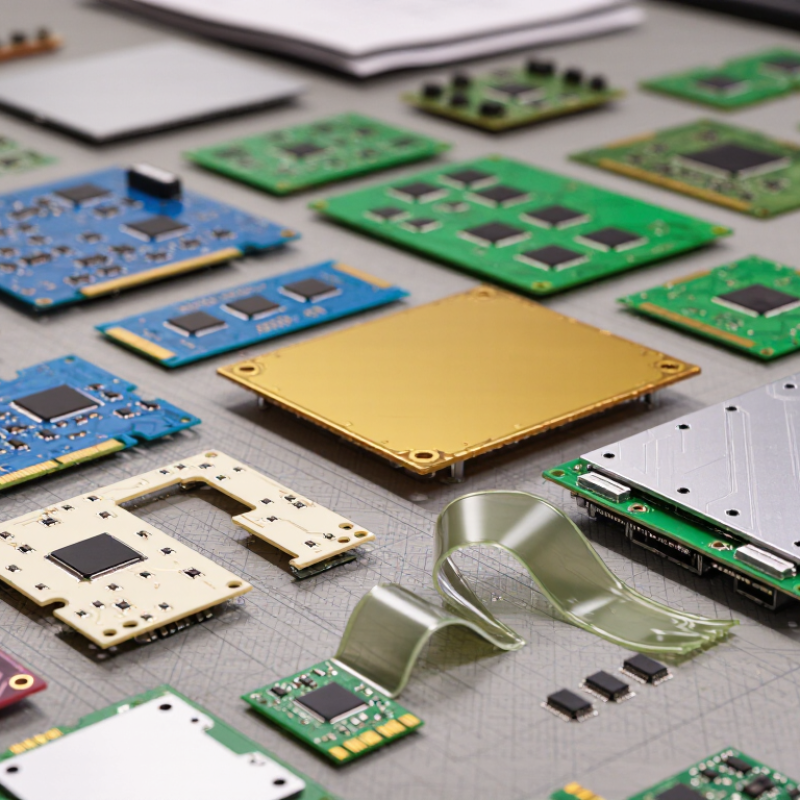
Circuit board materials are the physical layers that carry electricity, heat, and mechanical stress. A typical board uses copper foil, resin, glass fiber, and a dielectric laminate. The laminate controls insulation, strength, and signal speed. Copper carries current. Resin bonds the structure together.
IPC-4101E classifies laminate systems by performance requirements, including flame resistance, thermal stability, and electrical properties. In practice, material selection starts with operating conditions. High-frequency circuits need low-loss dielectrics. Power boards need stronger thermal paths. Flexible products need polyimide-based films that survive repeated bending. A cheaper material can become expensive after warping, delamination, or failed impedance testing.
The choice also affects environmental planning. The Global E-waste Monitor 2024 reported 62 million tonnes of electronic waste generated in 2022. That figure may reach 82 million tonnes by 2030. Material recovery is still difficult. Copper is valuable, but resin and glass fiber are not easily separated. I have seen designs optimized for electrical performance while ignoring repair and recycling. That is a weak trade-off. Designers should compare dielectric loss, glass-transition temperature, copper adhesion, moisture resistance, thickness tolerance, and documented compliance. The 2024 IPC International Technology Roadmap highlights signal integrity, thermal management, and sustainability as major development pressures. No material wins everywhere. The best choice depends on the circuit, factory process, service life, and evidence behind the supplier’s data.
The Main Types of Circuit Board Materials in 2026
The Main Types of Circuit Board Materials in 2026
Circuit board material selection now depends on temperature, signal speed, flexibility, and production volume. Standard FR-4 remains widely used because woven glass fabric and epoxy resin offer balanced cost and strength. It suits control boards, consumer electronics, and many industrial assemblies. High-Tg FR-4 supports hotter lead-free soldering processes and demanding thermal cycles. It is not universal. Some high-temperature designs still require polyimide, which maintains flexibility and stability in aerospace, medical, and compact electronics.
High-frequency boards often use PTFE-based laminates or other low-loss materials. These reduce signal loss in radar, wireless infrastructure, and fast communication equipment. However, PTFE processing can require tighter drilling and bonding controls. Metal-core boards use aluminum or copper beneath the circuit layer, helping move heat away from LEDs and power components. Ceramic substrates provide excellent thermal performance and dimensional stability, but their cost and brittleness need careful evaluation.
Flexible circuits commonly use polyimide or liquid crystal polymer films. They can fold around hinges, cameras, and wearable devices. Buyers should review dielectric performance, copper adhesion, moisture resistance, and flame ratings instead of relying only on material names. A cheaper laminate may create higher costs through warping, delamination, or failed testing. This is where sourcing decisions become less certain. Laboratory data may not perfectly represent humidity, vibration, or repeated assembly conditions. Small trial batches and documented qualification tests remain practical safeguards for global purchasing teams.
How to Compare Electrical, Thermal, and Mechanical Properties
2026 Best Circuit Board Material Types for Global Buyers?
Comparing electrical, thermal, and mechanical properties requires more than reading a material grade. Standard FR-4 laminates typically show dielectric constants near 4.0–4.5 at 1 GHz. Their dielectric loss is often around 0.015–0.025. These values suit many control boards, but they can limit high-speed signal integrity. IPC-4101E provides the material framework, while IPC-TM-650 defines testing methods. Always request test frequency and conditioning details.
Thermal performance changes the decision quickly. Typical FR-4 thermal conductivity is only about 0.25–0.40 W/m·K. Ceramic-filled laminates can exceed 1 W/m·K, while aluminum nitride may reach 170 W/m·K, according to technical data summarized in the 2024 IPC International Technology Roadmap. A lower thermal-expansion coefficient also matters. In-plane CTE may stay near 15–18 ppm/°C, but the z-axis can rise sharply near glass-transition temperature. That difference can stress plated holes during repeated heating.
Mechanical data deserves equal attention. High-Tg materials often provide better dimensional stability, yet they are not automatically stronger in every assembly. Check flexural strength, modulus, peel strength, and moisture absorption under IPC test conditions. A supplier may quote excellent laboratory values. Real boards still face drilling damage, connector pressure, and uneven copper heating. I would compare at least three laminate families using the same frequency, thickness, copper weight, and conditioning method. Otherwise, the comparison looks precise but remains misleading.
How to Select Materials for Different Board Applications
Material selection should follow the board’s working environment, not only its price. For standard consumer electronics, FR-4 remains practical because it balances cost, strength, and manufacturability. High-speed designs need closer control of dielectric constant and dissipation factor. Low-loss laminates reduce signal attenuation across long traces. High-temperature systems require higher glass-transition temperature and stable z-axis expansion.
Flexible boards need polyimide-based materials that tolerate repeated bending. Power converters and LED boards need strong thermal performance, often supported by metal-backed or thermally enhanced constructions. Prismark’s 2024 PCB Industry Forecast placed 2023 global PCB revenue near US$69 billion, with recovery expected in 2024. That scale increases material choices, but also increases sourcing risk. IPC-4101E remains a useful reference for laminate performance and qualification requirements.
Tips: Match Tg, CTE, Dk, and Df with the real operating conditions. Ask suppliers for test data, not only catalog values. Check performance after moisture exposure and thermal cycling. A material may pass laboratory testing yet fail in a crowded enclosure. That happens.
For automotive and industrial boards, CAF resistance, copper adhesion, and long-term thermal stability deserve attention. For radio-frequency applications, measure the actual stackup, since resin content changes electrical behavior. Cost models should include fabrication yield and field reliability. I would not select the cheapest laminate without reviewing drill quality and rework history. That shortcut can become expensive.
Global Buying Factors: Standards, Supply, Cost, and Sustainability
Choosing circuit board material in 2026 requires more than comparing laminate prices. Global buyers should match electrical, thermal, mechanical, and regulatory needs before requesting quotations. Standard FR-4 suits many digital and control boards, while high-Tg grades support hotter assemblies. Polyimide handles repeated temperature changes and flexible designs. PTFE-based materials serve demanding high-frequency applications, but fabrication requires tighter process control. Metal-core boards can move heat away from power components quickly. The choice becomes physical. Trace geometry, copper weight, drilling, and surface finish also affect performance.
Reliable sourcing starts with documented standards. Ask suppliers for IPC classification, safety certifications, RoHS and REACH declarations, and lot-level certificates. Some regions require additional chemical or environmental documentation. Check whether test reports match the exact resin system and thickness. They often do not. A capable supplier should explain tolerance limits, change-control procedures, and failure-analysis methods. I have found that a small sample run reveals more than a polished capability sheet. Inspect warpage, hole quality, solderability, and dielectric consistency.
Cost comparisons must include yield, freight, tooling, testing, and replacement risk. A cheaper laminate can become expensive after delamination or extra drilling steps. Supply stability matters too. Confirm approved alternatives, minimum order quantities, lead times, and storage conditions. For sustainability, compare recycled content, halogen-free options, energy use, and end-of-life handling. Environmental claims need evidence. Request certificates, not promises. Still, carbon data is rarely complete across the supply chain. That weakness deserves discussion. Buyers should record assumptions and review them when volumes, regulations, or designs change. No material wins every project.
